Key Takeaways
- The most effective member education campaigns equip brokers and HR teams with materials they can use right away. These resources make it clear what employees have, when to use their benefits and what to do next.
- Five materials do most of the heavy lifting: plain-language coverage guides, enrollment decision guides, focused one-pagers, short explainer videos and a communication plan that sequences what goes out and when.
- When you evaluate an ancillary carrier’s education support, look for clarity, a range of formats, language access, customization options, timing and how much it leaves for HR to explain.
Ancillary benefits only work when employees know how to use them. If someone skips covered preventive care or lets their coverage lapse because no one explained it properly, the plan underperforms and the questions land on HR. Brokers hear about it at renewal.
Most carriers offer education materials, often produced in bulk. What makes a resource library useful isn’t how much is in it, but whether the materials actually fit your group’s needs. You can check that before you ever place the plan. Here are the five materials to ask for, and how to spot the ones your clients will actually use.
1. Plain-Language Coverage Guides
A good guide answers coverage questions in the words employees actually use. It describes coverage by situation, not just by benefit category, and avoids jargon. It draws a clear line between what the plan pays automatically and what requires a step from the member. This is the foundation, and it’s where carriers most often miss the mark. An employee who just enrolled will get a certificate of coverage, but that’s rarely what they’re looking for first. They want to know if their cleaning is covered, what happens if they need a crown and whether they need to do anything before the appointment.
Renaissance’s guide to understanding your benefits, its member FAQs and its blog on benefits members can actually understand and use are written in that register.
The test: hand the guide to someone outside the benefits industry. If they can explain the next step they need to take to use their coverage, it works.
2. Decision Guides for Enrollment Choices
Explainers tell an employee what they have. Decision guides help them choose in the first place, which is a different job and calls for a different document.
This is especially important when employees are choosing coverage with their own money and don’t have a frame of reference for whether it’s worth it. A decision guide is written for the employee making a choice, not for the brokers or HR teams evaluating the plan. It walks through when the coverage may be useful, what it pays and doesn’t, and what employees should consider based on their own situation, using real scenarios to help them decide if it’s a fit.
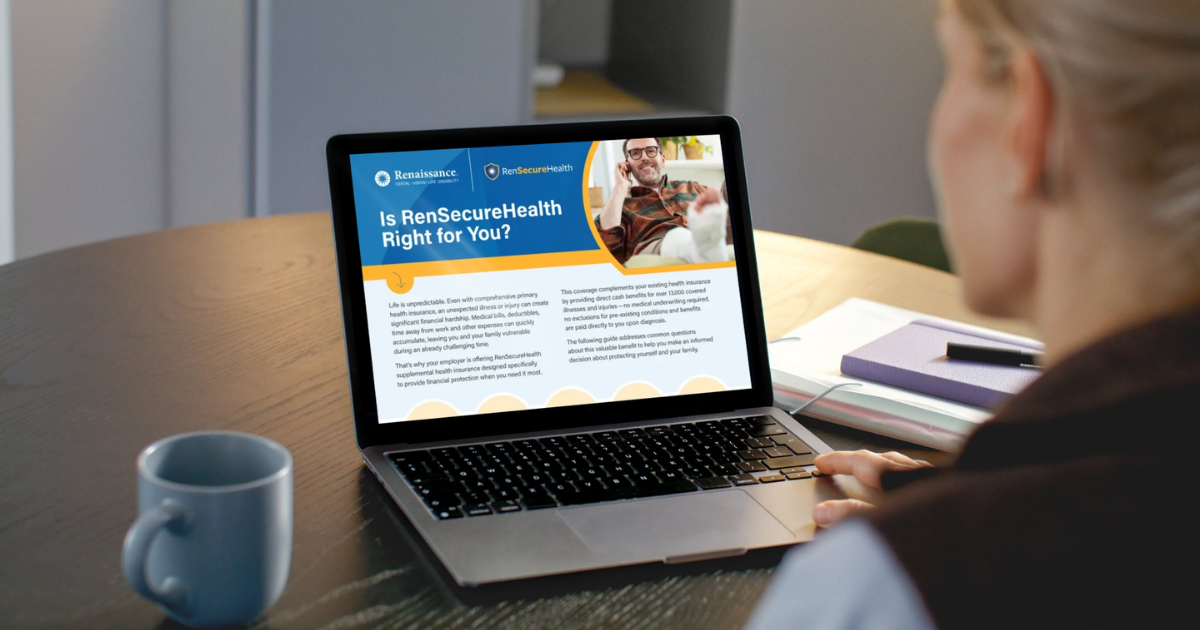
Supplemental health shows the gap most plainly. RenSecureHealth, Renaissance’s supplemental health product, pays a cash benefit on a covered diagnosis with no hospitalization required. It covers 13,000+ conditions, and payment generally reaches the member within about 72 hours of approval by direct deposit, Venmo or PayPal. None of that is intuitive to someone reading a plan name on an enrollment screen. Renaissance publishes an employee decision guide that makes the choice legible: what each coverage category pays, how claims get paid and what to weigh against the cost.
The test: look for language that helps employees weigh the coverage against their needs and cost. If it only lists benefits without helping them make that decision, it’s a pitch, not a guide.
3. One-Pagers and Infographics Employers Can Send As-Is
The best materials are easy for HR to send without rewriting or explaining the benefit from scratch.
A one-pager should stand on its own as a focused resource. It covers one topic clearly and gives employees enough context to understand what the benefit is, why it matters and what to do next. That focused, ready-to-send format is often more useful than a comprehensive brochure when HR needs to communicate about a single benefit.
Renaissance’s employer resource library and broker resource library are built this way, with a separate flyer for each of the Major Services Guarantee, the Vanishing Deductible and the Early Ortho Max Extender, rather than a single catch-all dental document.
Infographics serve a similar purpose for employees who prefer to scan rather than read. They make a single benefit easier to understand and easier for HR to share by email or in other enrollment communications.
What you want is a working library: organized by topic, downloadable without a login and available in the languages employees read for the materials they receive.
The test: can HR send the resource with a brief introduction instead of rewriting it or explaining the benefit from scratch? If not, the material needs work.
4. Short Explainer Videos
An employee reading on a phone during a shift break probably won’t open a PDF, but a short video can reach them.
The most useful videos are short and focused: how a product works, how to find a provider, how to use the member portal. The long corporate overviews tend to go unwatched. Beyond that, it’s about logistics: a library organized by product and by task, shareable by link so HR can drop a video into whatever channel the workforce already uses.
Renaissance’s videos cover the ground that matters here: product explainers for dental, vision, life and disability, a find-a-provider video and a RenSecureHealth overview.
The test: play one on a phone. If you catch yourself checking how much time is left, the employee will too.
5. A Sequenced Communication Plan, Not a Folder of PDFs
A folder of materials leaves HR to figure out what goes out, to whom and when. A campaign gives you the timing.
Three sequences cover most of the year:
- Annual enrollment. Advance notice of what is changing, then the plan-by-plan detail, then a deadline reminder.
- New-hire onboarding. A welcome piece for each product line the employee elected, plus member portal registration.
- Year-round. Provider lookup, claim filing and reminders about benefits people may have forgotten. This sequence drives utilization, and it’s the one most carriers tend to skip.
The carrier should hand you that timing. Renaissance covers the first weeks with welcome flyers by product line and a new member guide. Its member library carries the year-round pieces (provider lookup, portal access and claim filing), and its five-step strategy for communicating benefits value makes year-round sharing the fifth step.
The test: sort the samples by the moment rather than the product. If nothing is written for a new hire’s first month or the middle of the plan year, it’s inventory, not a campaign.
What Makes a Member Education Campaign Worth Plugging In
A strong member education campaign is one brokers and HR teams can use without having to rewrite it.
That may sound obvious, but in practice, most carrier education misses one of three marks. It’s written for someone who already understands deductibles and coordination. It arrives as a long document when the employee just needs a simple answer. Or it shows up once, during enrollment, and never again, so every question that comes up in month six lands with HR.
The materials that actually reach a distracted workforce tend to share four traits:
- Single-purpose. One topic, one page, one question answered.
- Portable. It travels by email, prints for a break room or posts to an intranet without a redesign.
- Sequenced. Something lands at enrollment, something at onboarding, something mid-year.
- Audience-matched. The version an HR director reads isn’t the version an employee reads.
How to Evaluate an Ancillary Carrier’s Education Support
Use this to score any carrier you’re considering, including your current provider. The gap between adequate and strong is where member confusion starts.
| What You’re Judging | Weak | Adequate | Strong |
|---|---|---|---|
| Clarity | Using technical jargon instead of plain language where appropriate | A readable summary of the plan | Answers written the way employees ask the question |
| Format Range | One PDF per product | PDFs plus one other format | One-pagers, infographics, video and web, by topic |
| Customization | Fixed PDFs only | Editable templates on request | Fillable and editable versions included as standard, matched to the group’s plan count and languages |
| Timing | Everything at enrollment | Enrollment plus onboarding | Enrollment, onboarding and year-round, with a piece for each moment |
| Who Explains It | HR writes the explanation | Carrier supplies content HR still has to rewrite | Carrier supplies ready-to-send material HR can forward unchanged |
| Audience Fit | One version for everyone | Separate employer and employee versions | Distinct broker, employer and employee versions with one consistent message |
| Consistency Across Lines | Dental is well represented; the other lines are thin | Every line has something, depth varies by product | Dental, vision, life, disability and supplemental health are all represented to the same standard |
To test whether the carrier supports employees beyond enrollment, ask for two examples: what an employee receives in the first week after electing supplemental coverage and what that same employee receives six months later. A carrier with a year-round communication plan should be able to provide both quickly.
FAQ
What communication materials should an ancillary carrier provide?
An ancillary carrier should provide, at minimum, jargon-free coverage explainers, decision guides for enrollment choices, one-pagers an employer can send untouched, short videos and welcome material for new hires, grouped by topic and in the languages the workforce reads. Renaissance’s broker and employer resource libraries are organized this way, grouped by topic and split by audience, with Spanish versions of the core member-facing pieces.
Can a carrier’s member education materials be customized for a specific group?
In many cases, yes, although the available options vary by product and material. Renaissance provides co-branded and adaptable resources for employer groups, including plan-summary one-pagers, FAQs, open-enrollment slide decks, email templates and webinar content.
Does Renaissance provide member materials in Spanish?
Yes. Spanish versions exist alongside the English versions across the core member-facing materials, including enrollment and welcome flyers, provider-lookup sheets and the dental claim form.
How do brokers reduce member confusion after enrollment?
Sequence the communication instead of front-loading it. Most post-enrollment confusion stems from information delivered once, during a window when employees are focused on elections rather than on how to use their coverage later. A year-round layer covering provider lookup, claim filing and portal access absorbs most of it. Renaissance’s member libraries include the provider lookup and portal components for that layer.
How should benefits communication differ for brokers, HR and employees?
Each audience needs its own version; a single document sent to everyone fits no one. Brokers need evaluation and positioning material, HR needs pieces it can forward without writing an explanation, and employees need answers in the words they’d use to ask. Renaissance splits its resources by audience: a broker library and an employer library built on the same core materials, each adding audience-specific tools on top, so the message stays consistent while each desk gets what it needs.
How Renaissance Shows Up
Renaissance’s education material is built to be forwarded rather than rewritten. All four traits are there: single-purpose materials, portable formats, something for every moment and audience-matched versions.
On your side of the table, the broker library adds a toolkit and strategy guide, tip sheets, a RenSecureHealth messaging guide and a service model overview you can bring into a finals meeting or a renewal review.
The service behind the material doesn’t change with headcount. Renaissance runs the same high-touch model no matter the group size or tenure, while much of the industry moves smaller groups toward self-service and call-center support. A dedicated account manager can point you to the right pieces for a given group, so you don’t have to read the whole library.
If education support is going to carry weight in your next ancillary placement, partner with Renaissance’s broker team on it.